One of the major selling points for playing Dungeons and Dragons Fifth Edition is that it is an immersive experience. It is, after all, a roleplaying game, and the point is to slip into the role of the character you’re exploring.
This can make having a passive player incredibly frustrating for both the other party members and the DM. Here are ten tips on how to get your players to fully engage in your games.
Know Your World
Use Visual Aids
Use Audio Aids
Utilize “Session Zero”
Create stories around characters
Play to classes
Allow decisions to make an impact in your world
Get to know and trust each other
Be a safe space
Play just to Play
Know Your World and Show Your World
As the DM, it’s your job to know everything about the world your players are exploring. This means knowing the map, the culture, the economy, the legends and rumors, the NPCs and how they interact with not only the group but each other.
When you know your world inside and out, you can put down breadcrumbs. You can offer throwaway descriptions for players and characters to grab on to, leading them into the main plot, without shoehorning, or into fun side quests that they actually want to engage in.
Drop-in these descriptions when your characters enter new spaces like taverns in a new town or a new road through the woods, or when they’re talking to one of your NPCs. Just be sure you have at least an idea of where these breadcrumbs lead.
Have a hard time thinking of side quests that include interesting rewards and NPCs you can use over and over? Check out my post Complete Side Quests for Levels 1-4! Or see my YouTube playlist filled with fun ideas for side quests!
Use Visual Aids
While playing a campaign in the “theater of the mind” (without a physical component) can be fun for some, players can often struggle to follow complicated battles and dungeon setups if they don’t have any references.
If you’re meeting in person, try incorporating tilemaps, miniatures, and spell effects into the gameplay, encouraging your players to keep a set of minis related to their character to use on the board. You might even consider giving them their own figures or stand-in pieces as gifts once you’re further into the campaign.
If you’re playing online, you can use sites like DnDBeyond and Roll20, which include digital, customizable maps and characters. Both sites offer character sheets or journals to record your progress, digital dice rollers (some of which with 3D animations) to hold players and DMs accountable, and private rooms for your group to play in.
If you are lacking in the visual aids department, you can pick up some amazing minis at a great price from our partners, Noble Knight Games. A pack like the one below is a great place to start if you are just starting to build your miniature collection.
Noble Knight has everything you need to create engaging experiences for all your players!
Use Audio Aids
One thing you can incorporate no matter how you play is background music! Create a playlist for your campaign’s setting on YouTube or Spotify, or, if you’re not sure what songs to add, use one that was made by other people.
You can also talk to your players about what kinds of music might represent their characters and encourage them to make playlists as well. This can help them get to know their characters and make roleplaying easier and more natural, getting players in the right headspace for the game.
Another great option is to use the app DMDJ. It is an incredible music mixer that allows you to create the perfect environment every moment of your game. See my full review of the app and a walk through in the video below!
Hold a “Session Zero”
A “session zero” is a personal session to introduce your player’s character into the game and have the party’s introduction to each other be more organic and make more sense story-wise. They can be done in bigger groups or one-on-one, depending on the length of the sessions and whether or not certain elements of characters’ backstories are supposed to be secrets in the game.
Session zeroes can be done retroactively if your player feels like they don’t have enough context to roleplay well. They are an excellent way to make players feel that their characters are important and feel they are playing an important role in the campaign.
Make Your Characters Part of The Story
A player might become passive if they feel like they can’t connect to the story you’re telling. To combat this, you can try incorporating elements of that player’s character’s story into the story of your campaign.
Are they a disgraced noble with a family back home? Maybe they get a letter saying their family is in danger and are given a chance to redeem themselves. Are they a wanted criminal? Maybe they run into bandits with a warrant for their arrest, looking for a reward.
If you incorporate a personal element into the story, they’ll be far more likely to engage, interact, and have a good time.
Play to Your Classes
Use the classes of your PCs to your advantage! Give your clerics a rival god’s follower to interact with, give your rogues an expensive treasure to hunt for, give your fighters…fights! Adding in class-specific fights can be fun for the whole party even as they’re letting your passive player take the spotlight.
Let your players show off their characters. Sometimes players can become passive if they don’t feel like their able to use their character builds to their full advantage. Individualized encounters can also give them confidence boosts when they don’t feel as confident with the character they’ve created.
Let Your Party Make an Impact
Your NPCs are not blind, nor are they stupid. Allow your characters to discover that there is gossip about them. Let a hush fall when they enter a room, or have a nervous child ask them to sign something. Everyone loves a good piece of gossip and teasing that can bring players more into the world.
Alternatively, it might be worth pointing out that your party hasn’t made an impact at all. This can encourage your players to figure out why that is and become interested in solving that mystery.
Let Your Party Get to Know Each Other
Your players are more likely to engage if they care deeply about their characters, and a good way to promote that is allowing your party enough downtime to get to know each other. Encourage them to sit down for a campfire chat while on watch or go out for drinks and get smashed after a job well done.
This can also provide your players with a mental break from the action without breaking a schedule you’re all comfortable with. Sometimes players just need a mental break from the heavier plot points of a campaign, so it’s okay if your session doesn’t progress the main story if it means that your players will have more fun later on. Let them wander!
Make Your Story a Group Effort
Sometimes your players will have ideas for scenes that they’d love to act on, but they may not want to step on any toes. They might also wonder why certain interactions went the way they did or be a little lost as to where they’re supposed to go next.
Sit down with them outside of sessions and bounce ideas back and forth. Ask for their input on where they want the story to go. You can also talk about where you want the story to go and give them suggestions for what direction to take in the next session so that they feel more confident.
Be A Safe DM
In the end, Dungeons and Dragons is very much just a game. It’s important to let your players know that they can trust you in and out of sessions. If introducing new elements to the story doesn’t help, then you should take your player aside and talk to them.
Players should feel safe andsupported in your group. Ask them if they have any issues with the other players, or if they have any problems with the way you’re running the game. Let them know that they can talk to you about any problems they’re having and that it won’t negatively affect how they’re treated at the table.
Play for The Sake of Playing
Your players want to have fun as much as you do. Explore different options to engage them and talk about it. Find whatever combination works for your group and the adventure you’re exploring. You have an entire world to explore, it should be a fun experience for all involved.
Until next time my friends,
May your game have advantage!
-Halfling Hannah
Want to Support Halfling Hobbies? Check out our custom Halfling Trinkets!
Curse of Strahd is a low-magic, high-fantasy setting. This is because the commodity of magic within Strahd’s domain of Barovia is scarce and the magic that once existed is either
The School of Illusion is a school of magic that specializes in deceit. Like the School of Enchantment, illusion spells focus on altering the perceptions of others to achieve your goals. This can be as innocent as creating an image in a 5 foot cube to as wicked as harnessing the nightmares of your enemies to drive them into madness.
No. Strahd Von Zarovich, the Vampire villian of the D&D adventure module starting back in AD&D, cannot be completely destroyed. Because he is the ruler of a Domain of Dread, if “killed” Strahd will regenerate within his Domain anywhere from a few days to months later.
So if you’ve got a player asking to be a lycanthrope or want to include a Big Bad Evil Pupper in your campaign, but you’re not sure where to start, this article is for you. We’re going to explore several ways that you can incorporate werewolves into your campaign.
Urban encounters in D&D 5E are defined by the presence of law enforcement, civilians, and the unique enemies that populate a fantasy city. Players are never entirely alone while they are within a city’s walls. The human element within an urban encounter infuses tension and emotion throughout. If you ever wanted to run an urban encounter, but don’t know where to start, this article is for you!
How a government handles disturbances is the key factor in any urban encounter. Decide for yourself the following three things:
For this town, what alignment is the average guard or law enforcement?
How well are they trained and equipped?
What is their standard response to a violent encounter?
Understanding Guard Alignment
Alignment is brought up here to help you determine how likely law enforcement is to follow the law and to what ends they do it. It will also explain their relationship to the players quickly. If the Guards are Neutral Evil and are called upon to arrest a powerful group of adventurers for starting a drunken brawl, they’re more likely to let them go in exchange for a personal favor rather than arrest them and charge them like normal people.
How well the Guards follow the law also dictates the player’s methods while working in town. If the Guards are Lawful Neutral and arrest anyone when they do something wrong regardless of stature, that encourages players to think creatively when trying to solve a problem like breaking into the warehouse they believe their friend is being held.
Their general strength and ability to help or hinder players matters a lot. If the players are chasing a serial killer and the local law enforcement refuses to help, that tells us: they don’t care, they are incompetent, or are otherwise occupied. If those same players that needed help with the serial killer get in a drunken bar fight and guards arrive to arrest everyone, that tells us they value quiet more than they value justice. They are probably Lawful Evil.
Shortcomings of City Guards
If the guards are too effective, then there isn’t really a need for heroes. Urban encounters often need a component to them that neutralizes or works around law enforcement as a whole. For example,a Vampire who is also a City Councilor will likely have a lot of influence and be able to convince officers that they are either above the law or threaten to fire them if they intervene.
Players having encounters in Urban settings should almost always be doing something that law enforcement can’t or isn’t equipped to handle. The range of that can be everything from stopping a hostage situation in progress, solving magical crimes that require special skills to investigate, to dealing with a Goblin problem that’s too dangerous for the commissioner’s conscience to send men with families to fight.
Being a witness can be more than just seeing and saying something to law enforcement. Word gets around the town of the heroes of villains affecting it’s day to day life. Even if this town doesn’t have a functioning press corps or a town crier, gossip always finds its way. This can help or hurt your players if their reputation is terrible or honorable. This can influence the way shopkeeps and innkeepers interact with the players.
Don’t forget, road rage is as old as roads themselves, even Ancient Romans had problems with traffic.A city that is alive will have activities that can help shape encounters. Maybe there’s a parade going on at the same time that the players are being chased by assassins. The players could blend in with the crowd and stealthily turn the tide on their pursuers. Conversely, if they are being pursued within a crowd, your local Wizard or Sorcerer will have to rule out casting Fireball unless they want to be ripped apart by an angry mob or be chased by law enforcement for the rest of their lives.
Camouflaged Monsters
At the back of the DMG from pages 302-305, Wizards of the Coast suggest monsters for every environment including Urban. There are humanoid stat blocks like Spellcasters or Bandits, but what we’re going to focus on is the kinds of inhuman creatures that have kept up with the times.
Broadly speaking, Urban environments are the happy hunting grounds of creatures that can shapeshift or look human. A short non-comprehensive list of these beasties includes:
Cambions
Doppelgangers
Oni
almost any variety of Vampire
and Succubi.
Their methods should reflect their relationship with the city as a whole. Given the bulk of them are predators, they’re likely to prey on the poor and the forgotten people within a city. That means the homeless, runaways, elderly, sick, and anyone else who can’t fight back is fair game.
Since their presence in the city is contingent upon their appearing human, they will fight tooth and nail to protect their reputation whatever that is. Exposing them as monsters to the general population should be difficult and should increase in difficulty the more influential they are. Bards were notorious in Celtic history for being able to shred the reputation of leaders and should be feared by these kinds of monsters.
The other variety of monsters to look at are those that are more comparable to animals, that learned how to blend in with the environment rather than the people. These kinds of monsters include:
Mimics
Gargoyles
and Water Weirds
Civilians could walk past these specifically every day and not be any wiser. They are more on the animal level of intelligence so they likely operate in things like sewers, cemeteries, or abandoned warehouses with as few witnesses as possible while still having some foot traffic. They won’t have social considerations, but they’re likely to know their environments pretty well and will be able to navigate better than someone who’s new in town.
There are only three other categories of creatures you might run into, but they aren’t as complicated.
Wild undead (Specters, Ghosts, Poltergeists. etc.). are possible enemies at sights of murders of graveyards.
Monstrous varieties of normal creatures (giant centipede, swarms of rats, giant wasps) will crop up in derelict areas without adequate protection.
Yuan-Ti, Kobolds, and Half-Ogres make up a small category of “humanoid but not quite” creatures that can disguise themselves with just cloaks and masks that you might encounter in small organized units, but likely aren’t the apex predator of an area. They are more likely to be trying to survive like everyone else.
What are some types of Urban Encounters?
Faction on Faction Conflict
There are many factions, both known and underground operations, that fight for territory in a city. Guards and the local Gang can be in open warfare. Two rival families, like the Hatfields and McCoys, can be competing in matters of honor. The Thieve’s Guild and the Tax Authority might be in conflict over how the Thieves are reporting low income but can afford land worth 30,000 Platinum pieces.
Important to remember with factions, they have reputations and connections. They can call upon friends to do favors like moving goods or making crime scenes disappear. Simply having more active members can do a lot for power imbalances, be they magical or martial. However, if the group starts to get a bad name or attract too much attention, they may need to reorganize or go underground if they want to keep a good grip on members.
How players resolve conflict or even what side they choose is always fascinating.
Investigations
Between private eye tales and horror mystery stories, there are a million things to draw inspiration from. Investigating an assassination by questioning witnesses, tracking the kind poison used, and figuring who had access to what and when always changes the priorities of players.
The roleplay of tracking a criminal coming to a head with combat can be anywhere from a flash in the pan to a slow burn adventure.
External Threats
External threats in a D&D urban sense would be something that threatens everyone in the town that originates from a source outside of the town. This can be anything from a flood to a plague to an invading band of Orcs that have breached the walls. How the players handle the situation is unique in an urban setting because of the responsibility and weight of the struggle. The urgency is turned up as every second they waste someone might be dying.
Pest Problem
The term “pest” here refers to any creature that requires a different set of skills than the average guard. In the real world, police are not called in to do the jobs of Big Game Hunters or Exterminators. Each division has special training that sets them apart. Even within urban environments, there are monster hunters.
For example, your players might be contacted to deal with what the Guards think is a wild animal that is attacking construction workers at night near a dig site, but it turns out to be a Gargoyle that is mounted on the nearby building that was attracted by the noise. Reversals and surprises can be super easy within an Urban setting.
Chase Sequences
(For a refresher on chase rules, please check out the DMG. pg. 252-255.)
If you’ve ever played Assassin’s Creed, you know how fun this is. Being on the run, dashing through buildings, jumping behind cover, all with your pursuers on your heels the entire time. Dashing through buildings is so much fun that the DMG literally expects you to and has SEVEN pre-built tables to help (DMG 113).
For example, your players are running from a Debt Collector who has mistaken them for someone else and isn’t taking no for an answer. They run for three actions straight and we need a complication. You roll a d20 on the Urban Chase Complication table (DMG 254) and the complication is a beggar laying in the road. You could try to push past, jump over, or scare him, OR you could pay him a comfortable sum of 5 Gold to get out of the way and trip the Debt Collector as he goes by.
We know it can be difficult to plan ahead during a chase sequence, so we encourage you to consider what part of town your players are in and select the hazards accordingly. This will help you tailor the experience to the town and make it feel dynamic and alive.
For example, the town may have a zoo they are known for. If your players dash through, you can require an animal handling check as they pass by the Owlbear cage, provoking an attack of opportunity on a failure. This may even slow their pursuers if they’re knocked flat on their back.
…and Carousing
Once again, the DMG expected this (pg. 128). However, let’s talk about how to use these tools rather than just pointing towards them.
During a night of carousing, the DMG recommends rolling a D100 + player level to determine the outcome. Let’s say the player rolled a 25, this means they now have made an enemy. The DM decides the offended party and the player decides what they did. While it is up to the player to decide how they offended their new enemy, if they are having trouble thinking of something or say “surprise me,” consider the following story:
“During all the merrymaking as the party relaxes and spends some of its hard-earned gold, your Wizard player finds themselves chatting up a local anti-war protest group. With their guard down and some drinks in their system, they may find themselves persuaded into joining in on a demonstration in front of the local Guard Garrison. The protest brings their drinks with them and throws them at the walls of the Garrison.
Your Wizard then intends to create a light burn mark as graffiti, and casts Firebolt. The alcohol catches alight and even reaches one of the windows with a bedroll that also catches flame. The visiting dignitary from a few towns over who was staying in the Garrison for safety awakes to his hair ablaze. He looks out the window and meets eyes with his new enemy.”
Always remember to personalize the flavor of your encounters and have fun with whatever the dice roll and work it to meet your players.
I only have 15 minutes to prepare for an urban encounter for my players. What can I do to make it work?
Ah yes, DM crunch time. I know it well. Here’s your ultimate quick build! We’ll list the steps as we go and build an example alongside.
Roll a d20 + d8 on the Random Urban encounter table (DMG. 114)
Example: 11, there is a fire. Your players will have the opportunity to put it out before it consumes a building or hurts anyone.
Roll a d20 and determine the nearest building that will be on fire (DMG. 113):
Example: 18, there’s a Shop nearby
Since we rolled a shop, we now roll a d20 to find out what kind of shop (DMG. 114)
Example: 1, it’s a Pawnshop. Maybe the shop keeper will feel like giving some of the goods after they save the building.
For additional details and story developments, consider the following:
Roll a d20 on the Current Calamity table:
Example: 9, there are Marauding monsters. It’s possible the fire could be their doing. For a list of possible monsters, consider the recommended monsters for Urban encounters on DMG 305.
Roll a d20 on the Race Relations Table (DMG. 112):
Example: 14, there’s racial tension rivalry. The fire could be arson by someone trying to drive a Half-Orc shopkeep out of town.
Roll a d20 on the Ruler’s Status (DMG. 112):
Example: 7, Xico is ruled by a feared tyrant. Authoritarians come in all styles, so this could go any direction. For this example, we’ll say he’s a laissez-faire tyrant that considers building fires a problem to be solved by the citizenry. The Half-Orc who owns the shop could report the fire, but it wouldn’t go anywhere. He may ask the players for help dealing with the attack on his shop.
The details of this story were all generated just using the tables in the DMG, one website, and some speculation and it has the makings of a good session. There are even more tables and resources inXanathar’s Guide to Everything. Don’t have it yet? Click the link to buy it and save $10 off retail price! (I love Noble Knight Games!)
Let’s say you’re struggling to know where to go next now that you’ve survived the first random encounter you had to throw together on the fly. Ask your players what they think is going to happen next. What’s incredible about the human mind is its ability to recognize patterns. When you present events or information in order, your players can take over and start seeing the storyline sometimes before you do. They can make order out of chaotic rolls and that’s honestly beautiful.
DM Tips to remember for Urban Encounters
Cities have personalities because of their inhabitants, what binds them together?
If everyone knows that the Baker on Kingston Road has ants baked into the bread, it’s going to come up. There will be phrases and nuances that are familiar to residents or frequent commuters.
Your players might not have any preexisting knowledge of the town, but their characters might.
Think about your player’s character backgrounds and what they might have done in the past. Even in the past, peasants had to travel into town to trade for goods. Soldiers had to go to fortresses to train. Scholars had to go to school somewhere. Having knowledge of the area as they arrive at it helps a player feel integrated with the world.
It’s ok if you don’t have every avenue planned and prepared.
To quote the DMG: don’t worry about naming every street and identifying the inhabitants of every building; that way lies madness.
Weather can still be horrible behind city walls.
While many wilderness effects are not applicable to an Urban setting, rain falls on the city and country alike. Feel free to use appropriate weather effects (DMG 110). If it’s the middle of a winter night and your players are running all over town in sub-zero weather, they might be risking frostbite.
In conclusion…
Urban encounters are some of the most diverse and interesting storytelling environments out there. You can tell almost any story humans can create within it. There are loads of charts and tables to take the headache out of running them, so don’t be afraid to try out city life in your campaign!
Curse of Strahd is a low-magic, high-fantasy setting. This is because the commodity of magic within Strahd’s domain of Barovia is scarce and the magic that once existed is either
The School of Illusion is a school of magic that specializes in deceit. Like the School of Enchantment, illusion spells focus on altering the perceptions of others to achieve your goals. This can be as innocent as creating an image in a 5 foot cube to as wicked as harnessing the nightmares of your enemies to drive them into madness.
No. Strahd Von Zarovich, the Vampire villian of the D&D adventure module starting back in AD&D, cannot be completely destroyed. Because he is the ruler of a Domain of Dread, if “killed” Strahd will regenerate within his Domain anywhere from a few days to months later.
So if you’ve got a player asking to be a lycanthrope or want to include a Big Bad Evil Pupper in your campaign, but you’re not sure where to start, this article is for you. We’re going to explore several ways that you can incorporate werewolves into your campaign.
Creating a pre-session list of what is needed to run the game is a great way to ensure that nothing is missed and everything is kept organized. Specifics of these lists can and should change from playgroup to playgroup, but there are some general categories that are worth including in any dungeon master’s checklist.
A complete dungeon master’s pre-session checklist should include:
Gathering resources
Noting down specifics about players and goals
Creating a general session idea and guide through session notes
A list of NPCs
A few possible encounters
A few possible side quests
Some of these sessions will be significantly shorter than others, and the most important of the different list items will vary from session to session. Read on to learn more about specifics for each one.
Gathering Your Dungeon Master Resources
Gathering resources so they can easily be accessed during gameplay is essential as a Dungeon Master. Resources include: sourcebooks for rules and monsters, maps, miniatures, in-game items, notes, etc. Anything that you need to run the game properly.
If you play in one location often, it is probably best to set up an organization system nearby that houses all the main resources such as books and miniatures. This way, you are less likely to lose or forget an integral game piece.
If you travel to Dungeon Master games, consider dedicating a bag to bringing along resources. Saving yourself the trouble of needing to pack and unpack resources every session will result in less prep time, less loss, and more consistent scheduling.
When figuring out what resources you will need for a session, turn to session notes and possible encounters. These two sections will likely dictate what resources are needed most, and you can adjust accordingly.
Need some resources to help track all this? Join the DMs League and get free resources delivered right to your email!
Make Sure to Have Player Notes
Player notes, in this context, means notes on your players that you have taken as the DM. This information can be about any part of their character, so it is best to break it down into one of two categories; Mechanic notes and story notes.
Mechanic notes are specifically related to how the player character interacts with the world, or information on their character sheet. This most often includes statistics like armor class, passive perception, and spell slots. How much you track these statistics vs. your player’s tracking them is a personal preference.
Story notes revolve around what a player character wants to do. This covers notes about family or background, goals, items of interest, connections, etc. Often, these are best when tailored to the session or recent sessions.
If a player expresses that their character would be interested in more magical weaponry, jot that down and present opportunities for that to come up in-game. Keeping notes on requests and interactions will keep your players more engaged in the game.
DMs League Freebie: PC Tracker
Make sure to sign up to get even more freebies just like this!
Keeping Session Notes
Session notes will often be the largest item on the DM’s pre-session checklist. At its core, session notes are a blueprint for running a session. There is a lot of information that can go in here, so it is important to find an organization system that works for you.
Consider leaving NPCs, encounters, and side quests to their own categories when creating session notes. This will allow you to have organized sections that you can quickly flip to as it comes up, while leaving other general information such as events in the session notes.
Session notes are meant to help you run the game. The exact level of detail that you put into notes or keep in your head or even improv on the spot will vary with personal preference. With that said, there are a few different categories that most session notes will include. These are:
General story notes – What is the villain up to? What will the party have to deal with next? How is the world reacting to events so far?
Area descriptions – What is the feeling around the next town? What is notable about the jungle the group is traveling through? Are there ruined castles nearby?
Big encounters – Keeping a list of encounters separate can be helpful for certain sessions, but if the party is inevitably headed toward some conclusion, keeping that encounter in the session notes with a more fleshed out plan can be beneficial.
Monsters – Keeping notes on what monsters may show up, where, and why can take encounters and elevate them to the next level.
Interesting Occurences – Including random, small events that fit in well with the area can make your world feel alive. This can be as simple as a street race or as intricate as a pickpocket targeting party lookalikes.
Keeping session notes organized will be hugely beneficial in speeding up play, so find a system that works for you. Starting with the above categories and adjusting as needed is a great option for beginners.
NPCs are Essential to a Good Session
NPCs make up the bread and butter of DnD content. These are every person that the party interacts with outside of themselves – if you, the DM, are controlling them, they are an NPC.
List Big NPCs The Party Is Likely To Meet
A list of important NPCs that the party is likely to meet in that session is great when planning and tracking a session. This list should include their name, what they do, what they look like, and some general personality notes. All of this it to help you play them when the opportunity arises.
Especially for important NPCs, it is best to make them unique and memorable. That way, the party will look back at the NPC encounters and trace it in the story.
Creating NPCs On The Fly
Creating a whole world of NPCs is obviously challenging, especially when trying to make each one unique. This becomes even harder as adventuring parties go in unforeseen directions, forcing you to improv a whole town of NPCs.
Keep a list of NPC ideas and names to easily build new ones when necessary. Names are the most important here, as it is incredibly common for a player to ask a local guard what their name is, leaving you stuck. Keep a list and simply cross off names as you use them, noting down where and when.
NPC ideas may seem like a challenging list to keep, but in reality, these should simply be small goals or notes. One could easily read “baker – has three daughters”. From this simple note, when combined with a name, a character can be formed and further fleshed out in play.
Make a List of Possible Encounters
Keeping a list of encounters, especially when the party is traveling, is great for controlling the pace of the game and keeping things interesting. Even if you are not a fan of random encounters, having a list of “set piece” encounters that you expect the party to run into is great for organizing and fleshing out ideas.
Anytime the player group is challenged with something they have to overcome, that is considered an encounter. This includes combat, skill checks, a difficult parley with some other force, sneaking into a place, etc. These are large encounters that often incorporate more than one player and can have dire consequences if failed.
Most often, an average 3-4 hour DnD session should have 4 to 6 encounters. This keeps the game flowing, exciting, and fun. Toward that goal, make a list of the encounters you think the party will run into while planning and set it aside. Consider it a map to guide the players toward if you notice they are stalling or getting bored.
Take Note of Possible Side Quests
While your campaign likely has a main quest that the party is either actively pursuing or ignoring, it is always useful to have side quest threads that the party can pull on. Not only does this make the world feel more alive, but it allows the party and group to take a break from one style of play and embark on another.
List a few possible side quests, their importance, the possible reward, and how the party might stumble upon them. Do not worry about including more than two or three, as these are often activities that can take a whole session.
When designing side quests, consider where the party is. This should inform a lot of other decisions about side quests, such as where the party will hear about it and what importance they hold. For instance, in a town, it is likely that there is a quest board, or the local innkeeper has some stories to tell of ancient ruins nearby. In the middle of the forest, maybe the party stumbles across a dying adventurer who asks for help or an unearthed tomb. Be creative!
Players want to be rewarded when they complete side quests. Many times, this reward can be tangible such as gold or weaponry, especially if offered by a town. However, for other side quests such as those given by animals, gods, or stumbled upon, consider other forms of reward. This could include boons, friendships, messing with a villain’s plans, etc. These are all valuable and will come up later in play.
If you need some ideas, check out my playlist of complete side quest!
You’re Set For Your DND Session
By spending a few minutes to get your checklist together and plotlines in order, you’ll be DMing an incredible session in no time!
Curse of Strahd is a low-magic, high-fantasy setting. This is because the commodity of magic within Strahd’s domain of Barovia is scarce and the magic that once existed is either
The School of Illusion is a school of magic that specializes in deceit. Like the School of Enchantment, illusion spells focus on altering the perceptions of others to achieve your goals. This can be as innocent as creating an image in a 5 foot cube to as wicked as harnessing the nightmares of your enemies to drive them into madness.
No. Strahd Von Zarovich, the Vampire villian of the D&D adventure module starting back in AD&D, cannot be completely destroyed. Because he is the ruler of a Domain of Dread, if “killed” Strahd will regenerate within his Domain anywhere from a few days to months later.
So if you’ve got a player asking to be a lycanthrope or want to include a Big Bad Evil Pupper in your campaign, but you’re not sure where to start, this article is for you. We’re going to explore several ways that you can incorporate werewolves into your campaign.
Lycanthropy in Dungeons and Dragons 5E grants players immunity to piercing, slashing,and bludgeoning damage from non-magical or non-silvered weapons, increased ability stats, allows players to shapeshift, and grants new features according to the sect of lycanthropy(bear, rat, boar, wolf, or tiger).
Lycanthropy is more than just a curse, it is a set of lore and mechanics you can use to challenge your players or even grant them a powerful new set of abilities.
What is Lycanthropy?
In D&D 5e, Lycanthropy is a curse that can afflict individuals granting them shapeshifting as well as new traits and abilities.
On a daily basis, those afflicted will have to confront the curse and the desires it brings. Most cursed humanoids will give in and allow themselves to be permanently changed by the curse allowing it to turn them into predators always looking for a weak target.
Some will try to suppress it and ignore it, but will always be tormented by nightmares of the times they lost control. A small few will grapple with and master their curse, able to fluidly move through their human, animal, hybrid forms as they see appropriate and live mostly normal lives.
Those that master their curse are the rare exception.
All Lycanthropes face a test every month when the moon is full and the beast inside is at its strongest. This is when those who fail to control it are stripped of their humanity and do whatever their nature guides.
There are even Lycanthropes who are unaware of their condition that go out to prowl on the night of a full moon who experience fugue-like symptoms when they become human again. They may even try to invent stories to justify the gaps in their memory.
Spreading Lycanthropy
The Curse of Lycanthropy spreads two ways: bite and tusk attacks as natural weapons inherent to a Lycanthrope’s transformation or being born into the curse as the child of a Lycanthrope.
The risk of being infected with Lycanthropy is decided by a saving throw against the creature’s infection DC. This is calculated by 8 + proficiency bonus + the Lycanthrope’s Constitution modifier. Lycanthropes can spread their curse quickly, but each subsection of the curse has its own set of feelings about that, which we’ll discuss further.
Damage Immunity
We need to talk about one of the most important considerations when it comes to Lycanthropy: All forms of Lycanthropy are immune to non-magical/non-silvered bludgeoning, piercing, and slashing damage.
The only thing that scares a lycanthrope is a spell caster and adventurers wielding magical OR silvered weapons. Either option can end their seemingly invincible reign making such PCs direct targets.
This immunity to damage applies to both Player Character and non-player characters. If you have a silvered weapon, you can hurt them. If you have a +1 weapon, you can hurt them. If you have a magical and silvered weapon, you can hurt them. Otherwise, they are immune to the damage, making them very difficult to kill.
Understanding Lycanthropy for PCs
When a person becomes infected with Lycanthropy, they retain their game statistics, except as their curse specifies. These exceptions include speeds in non-humanoid form, immunities, traits, and actions that don’t involve equipment. Every Lycanthrope also increases one statistic if they are under the minimum cap. The DM has the final say as to how the alignment is applied.
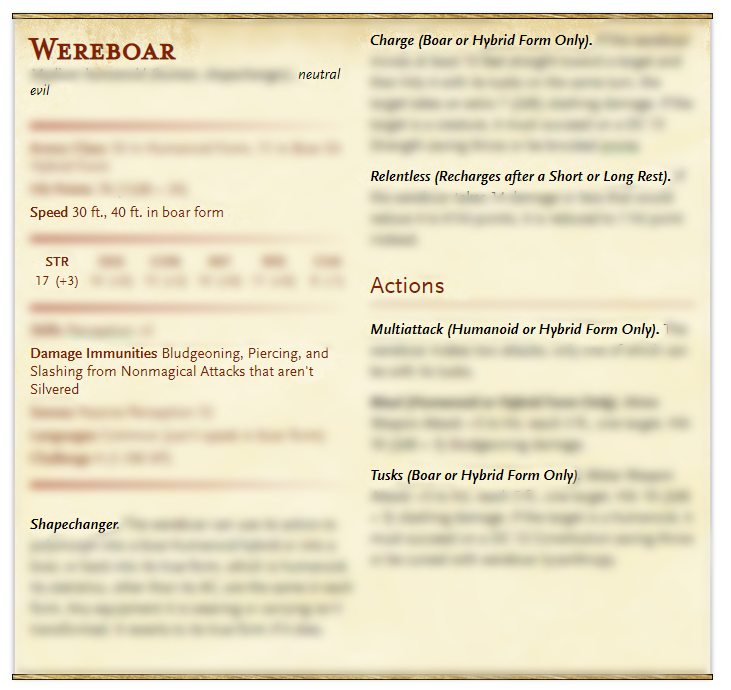
Here’s a visualization of all the modified attributes for a Wereboar that are added to a character. Similar game stats are found for all forms of Lycanthropy in theMonster Manualon pages 208-211.
What are the Types of Lycanthropy?
The unifying factors of all Lycanthropes are their immunities, their ability to spread the curse, and the inherent personality that come with the curse. Beyond that, Lycanthropes show a small variety of abilities specific to their curse. Many increase Strength and one increases Dexterity abilities. If a player’s original stat is higher than their cursed stat, the ability score remains the same.
Str. Boost
Dex Boost
Natural Weapons
New Traits
Adds 1 to AC shifted
Werebear
Up to 19
N/A
Bite (2D10+Str) Claw (2D8+Str)
Keen Smell
Yes
Wereboar
Up to 17
N/A
Tusks (2D6+Str)
Charge, Relentless
Yes
Wererat
N/A
Up to 15
Bite (1D4 + Str or Dex)
Keen Smell
No
Weretiger
Up to 17
N/A
Bite (1D10+Str)Claw(1D8+Str)
Keen Hearing and Smell, Pounce
No
Werewolf
Up to 15
N/A
Bite (1D8+Str)Claw (2D4+Str)
Keen Hearing and Smell
Yes
Lycanthropy Features explained:
Charge: If the Wereboar moves at least 15 feet straight toward a target and then hits it with its tusks on the same turn, the target takes an extra 2d6 slashing damage. If the target is a creature, it must succeed on a Strength saving throw (DC determined by the 8 + proficiency + Wereboar’s strength) or be knocked prone.
Keen Smell: Advantage on perception checks based on smell
Keen Hearing and Smell: Advantage on perception checks based on hearing or smell
Pounce: If the weretiger moves at least 15 feet straight toward a target and then hits a creature with its claws on the same turn, it must succeed on a Strength saving throw (DC determined by the 8 + proficiency + Weretiger’s strength) or be knocked prone. The Weretiger can then make a bite attack as a bonus action.
Relentless: If the Wereboar takes 14 damage or less that would reduce it to 0 Hit Points, it is reduced to 1 hit point instead. Recharges on after a short rest.
Werebear:
Alignment: Lawful Good
General Personality: solitary, kind, cautious
Traits in Humanoid Form: broad-chested, built, and hairy in the same color as their fur
Favored Territory: remote locations
Social Preference: prefers isolation
Likelihood to infect others: Low. The only time they are willing is on those they believe can control it
Werebears are the good ones. Given their preference about how they spread their curse, it’s unlikely anyone would find an Evil person struggling against their new Good nature (but it would be an excellent subversion). If an established NPC that the players know already becomes cursed by a Wearbear, that NPC may need to take a mysterious vacation to their private cabin in the woods every full moon. Given the Lawful Good standing, they might start feeling guilty about old habits, like skimping on taxes. They might even find themselves drawn to do good work within their community as a manifestation of their Werebear nature to protect their territory.
Wereboar:
Alignment: Neutral Evil
General Personality: violent, antagonistic, durable; love charging into combat headfirst
Traits in Humanoid Form: stocky and swole with short bristle-like hair all over their bodies
Favored Territory: remote locations
Social Preference: Gangs or family members of Wereboars, occasionally ally with Orcs
Likelihood to infect others: High. They like watching people suffer under the curse.
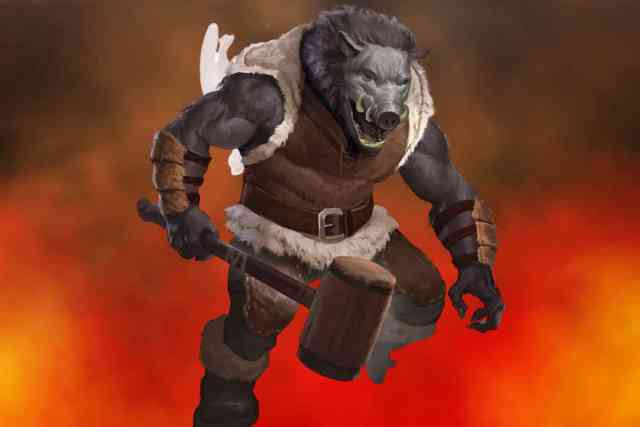
The bestial nature of Lycanthropy curses is fully realized in a Wereboar. Their traits, as well as the Werewolf’s, are easy to handwave as simply the desire to destroy and nothing more. However, their behavior suggests a set of priorities. They like to travel in groups of their peers which suggests that they can see eye to eye with members of their own kind. They can be violent to outsiders, but still, have a soft spot for their family. Orcs love strength almost as much as they love their gods, so maybe Wereboars have a similar disposition and respect displays of physical power.
A character’s Intelligence and Wisdom scores are NOT lowered when they become a Wereboar, so when they charge headfirst into combat it isn’t because they suddenly got dumber or have worse judgment. My suspicion would be that they feel the most natural when they are in the thick of a fight and are actively looking for a reason to do so. This could be roleplayed such that all other worldly pleasures are sort of muted like being high on painkillers; but when they fight they feel alive.
Wererat:
Alignment: Lawful Evil
General Personality: clever, shifty, and calculated; prefers to ambush
Traits in Humanoid Form: twitchy and paranoid with thin hair and quick eyes
Favored Territory: sewers, cellars, catacombs; close enough to feed off civilization without getting involved
Social Preference: solitary or in organized crime circles; oftentimes keep Giant Rats
Likelihood to infect others: Low. They only give it out to members of their gang and kill anyone accidentally infected or rogue members.
Wererats are tricky to roleplay. Next to Werebears, they are the most likely to have gotten their Lycanthropy from someone they know. Someone who becomes a Wererat 9/10 knows what they are getting into so they likely had a similar profile before they transformed. A Wererat curse to someone expecting it would likely amplify those traits to the extreme.
Maybe they were careful before, but it manifests now as general anxiety about the world. They are paranoid and see enemies in every shadow. They are lawful so they seek to impose order on their lives. Wererats might even have a sort of collective code they all obey, similar to real-life organized criminals.
If a character was claustrophobic before becoming a Wererat, they might be in a strange place now where they are actively afraid of going to closed-in spaces, but feel safe when they get there.
Weretiger:
Alignment: Neutral
General Personality: proud, ferocious, and detail-oriented hunters
Traits in Humanoid Form: tall and meticulously groomed
Favored Territory: jungles and fringes of society, but close enough they can travel in to trade and party
Social Preference: alone or in small family groups
Likelihood to infect others: Low. Another Weretiger is just competition.
“Pride is not the opposite of shame, but it’s source.” -Uncle Iroh, Avatar the Last Airbender.
While a person could go in a lot of different directions with Weretigers, the one we’ll explore here is a little more abstract: insecurity.
The portrait we get of a Weretiger is a highly competitive, proud hunter who cares a lot about his appearance. That is a person with something to prove. They want to be known as a composed accurate individual that strikes at just the right time. A Player or DM might apply this as a hyper-awareness of their character’s curse as a Lycanthrope and is out to prove all the ideas about them being slobbering monsters wrong. Fearing being branded as a savage, they strive to embody a lot of high society ideals while still feeling like they don’t belong around normal people.
Werewolf:
Alignment: Chaotic Evil
General Personality: savage almost to the point of being rabid
Traits in Humanoid Form: volatile, prefers raw meat, carefully attuned senses,
Favored Territory: wildlands with lots of hunting ground
Social Preference: forms packs with Wolves and Dire Wolves
Likelihood to infect others: High. Werewolves are Chaotic Evil and will fight anything tooth and nail.
Werewolves just love fighting, tearing, being the boss, and being alone. These traits on their own can be really toxic, but they can enrich a character if done right. The key is the why.
One of the things that sets D&D apart from other storytelling mediums is the amount of exposure you get to a character or an idea. As part of that, sometimes you roll the dice and you lose. As already stated, Werewolves love fighting, but one might suspect they hate losing. Maybe after a loss, a Werewolf knows how bad their temper can be and seeks isolation to lick their wounds and process it before they make another mistake. Losing could sharpen their minds to a fine edge, overriding their need to fight everything, and focusing only on besting the one creature that defeated them.
Maybe after being defeated, they submit to the winning party and trust them to lead them to more victories. If a character tries to deny their love of violence, maybe they seek to burn off frustration in organized fights, but avoid conflict in any place that could actually kill someone.
Not every application of Lycanthropy has to be an in-depth character overhaul though. Maybe a Werewolf manifests his qualities as a love for animals and wide-open pastures. They might know the best springs in the wilderness from their constant hunting. A character in this game is made for the enjoyment of everyone, so adjust as necessary to fit your game.
How to Use Lycanthropy with NPCs
Once you have updated the NPC’s mechanics with the above chart and immunities, Lycanthrope NPCs need two considerations: what is the relationship to their curse and how do they interact with their new instincts and abilities?
How Were They Cursed?
Let’s explore how they got their curse first. Did they get it when they married into a family? Did a Wereboar infect him just for giggles? Were they willing participants? Were they born to it? Once that question is answered, decide their personality and the new feelings they have which might influence their decisions.
There are hundreds of directions you can go with a curse like this.
How do they cope with their new compulsions?
While Werewolves are the mad dog type, a Lycanthrope of the Weretiger variety might manifest his cleanliness in every part of his life. He might become angry if he was having a night on the town in a perfectly pressed robe and someone has the audacity to spill a drink on it. A Wererat might manifest general anxiety that leads them to seek more and more power to make themselves feel safe.
If you have a Wizard NPC that charges into combat like a madman, it might be because he’s secretly a Wereboar.
If an NPC loves the thrill of combat, are they bored by their resistance to damage or does the power intoxicate them? If they were timid before, are they afraid of hurting other people and seek solitude? Do they know magic well enough to know that the curse can be reversed?
Each Lycanthrope comes with its own general profile and you, the DM, decide how much of that you want to incorporate. There will always be exceptions to these behavior patterns and you should feel free to break them for the sake of the story. But, generally, these rules apply to the behavior of were-NPCs.
How to use Lycanthropy with Player Characters
This is going to be one of those moments where you need to talk to the entire table before you allow something. Establish what Lycanthropy means in your game. Decide beforehand if it is well known and what stereotypes there are about Lycanthropes. Talk to your players about what struggling against the curse or embracing it means. They need to understand the responsibility of their power and their ability to spread the curse even on accident.
It is a curse and it should be role-played that way. It’s more than just free powers. It helps define a character.
Lycanthrope Player Characters and non-Player Characters gain the same powers. This includes gaining immunity to non-magical and non-silvered bludgeoning, piercing, and slashing damage. However, even some individuals that work for the Wizards of the Coast don’t house rule it this way.
Many DMs might be frustrated by the proposition of full out immunity to the most basic of attacks. We would like to compare this to the Aaracockra race. Both of them require advance planning by the DM to actually challenge that player.
A lot of the basic monsters follow a brute approach in that they have a lot of health and hit hard with a melee weapon. For example, most of the NPC stat blocks have a crossbow option in the back of the Monster Manual, but since the priority is on strength, their chance to hit and damage are poor. With an Aaracockra, just flying out of range can mean they miss a lot of the crossfire and chaos. What Aaracockra and Lycanthropes have in common is that they can both be countered by an enemy casting Firebolt.
I’m not saying that every enemy your party faces needs to cast spells. That would get predictable fast. However, poison dart traps could still hurt a Lycanthrope. Fire damage from being beaten with torches can hurt them. Undead, like Specters and Wights, can hurt them. At high-level play, it’s a 50/50 chance that a boss creature has magical weapons anyway. Lycanthropes can die from fall damage as it turns out as well, allowing the creative DM ways around this seemingly broken mechanic.
The encounters the DM sets before a party decides what is powerful. If the Lycanthrope in your party is outshining the other players, it isn’t right for your table.
House Rules for Lycanthropy
If you are interested in allowing a player to roleplay a PC with lycanthropy, or you are thinking of adding it to your game as a potential risk to your players, I would suggest implementing the following house rules to ensure it doesn’t get out of hand.
Level 1
New Actions and New Traits, Added AC on transformation
Level 3
Stat Increase, Natural Weapons
Level 5
Resistance to non-magical, non-silvered, Bludgeoning, Piercing, and Slashing
Level 10
Immunity to non-magical, non-silvered, Bludgeoning, Piercing, and Slashing
At Level 1, it should almost be treated as an augmentation of their race. The abilities are similar to the Unearthed Arcana of the shifters. They do not yet have resistance or immunity to damage and you can roleplay this as the curse just beginning to take hold of the player.
At Level 3, the Stat Increases and Natural Weapons can arrive at the same time as most Martial subclasses. Because they are largely physical buffs, Lycanthropes can gain their abilities at roughly the same rate as Martial Classes. Monks wielding the Natural weapons of a Werebear could affect game balance, so use it at your discretion. They may only gain one of the two damage dice that Werebears get on their attack at Level 3 then gain the second at Level 7 or so.
At Level 5, they gain Resistance but notImmunity to Bludgeoning, Piercing, and Slashing. Level 5 is a milestone where the players can start fighting creatures much bigger and more dangerous than themselves. If you have a Barbarian in your party who is not a Lycanthrope and a party member who is a Lycanthrope, I would take this opportunity to show the difference between a Barbarian’s Rage and this Lycanthrope feature in a quick combat encounter. Magical and silver weapons cut through a Lycanthrope’s resistance, but not a Barbarian’s.
By Level 10, they have reached the tier of play where they are national heroes and a force to be reckoned with. There’s a much wider variety of creatures that wield magic weapons at this level so it closes the power and planning gap on the DMs part.
As a reminder, Lycanthropy does not negate other abilities. That means, your Wizard can shift into a Werebear and keep on casting Fireball. (That’s enough to send a Bandit Chief running for the hills!)
DM Tips to Remember when using Lycanthropy
This is a curse, not a disease.
That means a Paladin’s Divine Health does not protect it from Lycanthropy. Lesser Restoration can not fix this. For those infected, a Bestow Curse spell can cure it. If they are born to it, it is essentially part of their race. Only the Wish spell or a greater being can take Lycanthropy away.
Each Lycanthrope has its own personality influences on transformation.
Not every Lycanthrope is a bloodthirsty maniac. Not every Lycanthrope is as kind as Smokey the Bear. There’s variety within Lycanthropy. Of Lycanthropes, three kinds are evil, one is Neutral, and one is Good. Those instincts should have bearing on how a Lycanthrope is played, either for or against those instincts. Struggling or embracing the nature of the beast is critical.
Half-Orc Wereboars are difficult to kill.
Because Orc and Wereboars often work together, it would make sense for there to be some half-orc wereboars. Such a creature would be extremely difficult to kill because of its combined traits “Relentless” and “Relentless Endurance.” When a half-orc is reduced to zero hit points the “Relentless” trait brings them back to one hit point. Similarly, when a Wereboar is reduced to zero hit points by damage of 14 points or less, the “Relentless Endurance” trait brings it back to one hit point. This means a half-orc wereboar will have two chances at life before being brought down. It could be a problem for DMs and Players alike!
Lycanthropy is used as a catchall for were-animals in D&D but is denotatively wrong.
Lycanthropes are considered shapechangers but still qualify as humanoids. This is especially important for spells. Hold Person, a spell that freezes a humanoid in place would still work on a Lycanthrope. However, normal spells that ward against evils like Fiends and Undead such as Protection from Evil and Good will not protect you from a Lycanthrope’s wrath.
In conclusion…
Lycanthropy can change the dynamics of your game dramatically. It’s one of those tropes that when done right, it’s so fascinating to watch play out. Watching players struggle with the moral choices and implications of their NPC friends and enemies is pinnacle high drama. Not only that but playing an engine of destruction made of fur and fury is just as fun too.
Curse of Strahd is a low-magic, high-fantasy setting. This is because the commodity of magic within Strahd’s domain of Barovia is scarce and the magic that once existed is either
The School of Illusion is a school of magic that specializes in deceit. Like the School of Enchantment, illusion spells focus on altering the perceptions of others to achieve your goals. This can be as innocent as creating an image in a 5 foot cube to as wicked as harnessing the nightmares of your enemies to drive them into madness.
No. Strahd Von Zarovich, the Vampire villian of the D&D adventure module starting back in AD&D, cannot be completely destroyed. Because he is the ruler of a Domain of Dread, if "killed" Strahd will regenerate within his Domain anywhere from a few days to months later.
So if you’ve got a player asking to be a lycanthrope or want to include a Big Bad Evil Pupper in your campaign, but you’re not sure where to start, this article is for you. We’re going to explore several ways that you can incorporate werewolves into your campaign.
Pets in Dungeons and Dragons can be a great way to increase both morale and emotional investment in a group of player characters, but they have to be appropriately used to prevent problems. Throwing someone’s pet into a gnarly combat situation can be a formula for a death scene that will scar your players for life.
Pets in Dungeons and Dragons can be a great source of role-play and fun, as well as an incentive for characters to explore nearby areas and bond together as a party. Pets that are not familiars or animal companions should be relegated to non-combat to avoid being killed in an encounter.
If you don’t know the difference between an animal companion, familiar, and pet, be sure to read this article which fully explains the differences. (There are more differences than you might think!)
While pets might just seem like one more thing the Dungeon Master has to keep up with, they can also add a lot of fun and flavor to the game and I hightly recommend you give them a try!
A Pet is Different from a Familiar or Animal Companion
Unlike a familiar or animal companion, pets are typically acquired more for roleplaying and immersion purposes rather than as an extra meat shield in combat. Often, pets in a Dungeons and Dragons campaign end up becoming a character or party’s mascot for roleplaying purposes, but more powerful creatures can also be used in combat.
Familiars are different from pets in that they aren’t beasts—instead, these creatures are classed as Celestial, Fey, or Fiend depending on the choice of the player. Players are also able to take several actions with a familiar that they are unable to take with a regular non-combat pet, such as seeing through a familiar’s eyes or communicating telepathically. Familiars are used by the Wizard class. (see more on familiars)
Animal Companions are also different from pets in that these animals usually form some type of utility role within the party—for example, a beast of burden such as a horse will carry a rider or supplies, and a Beast Ranger or Druid’s animal companion will participate in combat. Animal companions are only accessible by the Beast Master and Druid classes. Beast Masters may treat their beasts as a pet, but it is still a trained animal used for combat, not for snuggles.
Non-Combat Pets can be acquired by any character regardless of class and can be trained by anyone with the Animal Handling skill. These pets (usually smaller or scenario-based) can help the party in non-combat scenarios but should be ordered to a safe distance in hostile encounters. The type of non-combat pet depends on the campaign, and there are limitless ways for players to acquire them.
How Do Player Characters Acquire Pets in a DnD Campaign?
Player characters can acquire pets in all kinds of different ways in a campaign, and the DM can help to facilitate these actions. Here are some of the various ways that a player character could theoretically acquire a pet:
As a reward for helping a wizard or other passerby (quest reward)
Bought from a market
By using the spell Speak with Animals to befriend local wildlife
Finding an egg or abandoned baby creature
Being bestowed the pet as a gift
The situations that could potentially lead up to the party acquiring a pet are as diverse as the imaginations of the DMs. There are plenty of creative opportunities in almost any DnD campaign to shoehorn in a chance to take on a non-combat pet for one or all of the player characters.
While Non-Combat Pets also don’t have an impact on hostile encounters, their skills can be used outside of combat to aid the party in a variety of ways, from sneaking out of a jail cell and stealing a key from a guard to alerting the party to an attack in the wilderness in the middle of the night.
The utility of non-combat pets is a direct reflection of the DM’s creativity in using them as part of the campaign. A good DM will look for opportunities to allow the players to roleplay with their pets and use them in the story.
What Kind of Pets Can DnD Characters Have?
It is best to avoid giving players overpowered pets right from the start, so choosing lower-level animals for early campaign pets is a better choice. Here are some of the various pets that could be taken on by the party:
Guard or hunting dogs
Falcons or other domesticated birds of prey
Parrots or singing birds
Small rodents (rats, weasels, squirrels, rabbits or ground hog)
Lizards, turtles and frogs
Here is an extensive list of potential pets that you might give your player characters. Choosing pets that fit the theme of the campaign is also a good idea—for example, if much of the campaign will take place underwater, many aquatic pets would be an excellent choice as companions.
What Can Pets Do?
Non-Combat Pets can’t do much, especially when thrown up against combat pets such as familiars or companion beasts. Instead, pets are used as a flavor element in roleplaying and can be utilized circumstantially in campaign encounters outside of combat.
Players with Speak with Animals or Animal Handling could potentially train their pets to perform some minor commands for the party at the discretion of the DM. Players (and the DM) need to be aware of any pets that are tagging along in the party and keep in mind how they would potentially react to ongoing situations.
For example, an untrained dog might bark and give away the party during an ambush attack, or a housecat may knock over and destroy a valuable artifact. If a pet is used in combat, the rules are the same as for a summoned creature—the DM controls the pet’s actions.
To figure out how pets will be incorporated in the campaign, the best thing to do is ask the players themselves why they want pets and what they want to do with them. This can help the DM get a better handle on the types of pets that are suitable for the campaign—including which pets they could reasonably come into the game with, and which pets could be acquired later.
Don’t Kill the Pet!
While as the DM you might occasionally find some of the antics of your party’s pets to be annoying or distracting, especially if one of the players gets overly attached to their pet, it is always a bad idea to use campaign situations to kill them off. Not only does this decrease morale for the entire party, but you’re also increasing the chances of causing a serious rift in the game by doing so.
However, if a Beast Master or Druid’s combat pet falls in battle because of unforeseen scenarios, let the dice fall where they may. A good rule of thumb is that if a player wants their pet to have mechanical value and fight in encounters, it has to be vulnerable to death as a result. Otherwise, if a player wants their pet to remain safe, it must be designated as a non-combat pet only.
Pets Can Add More Fun to a DnD Campaign
They might require a little more planning to incorporate, but player pets can be a fun way to help players bond together as a party and increase the amount of fun everyone is having during the campaign.
Not only do pets act as a mode of expression for players, (and maybe even a form or therapy!) but they can also set up some great comedic moments or epic saves in the story that will have players talking for months to come.
Until next time, my friends,
May your game have advantage!
-Halfling Hannah
Halfling Hannah
Want to Support Halfling Hobbies & Local Artists? Buy from our Trinket Shop!
Curse of Strahd is a low-magic, high-fantasy setting. This is because the commodity of magic within Strahd’s domain of Barovia is scarce and the magic that once existed is either
The School of Illusion is a school of magic that specializes in deceit. Like the School of Enchantment, illusion spells focus on altering the perceptions of others to achieve your goals. This can be as innocent as creating an image in a 5 foot cube to as wicked as harnessing the nightmares of your enemies to drive them into madness.
No. Strahd Von Zarovich, the Vampire villian of the D&D adventure module starting back in AD&D, cannot be completely destroyed. Because he is the ruler of a Domain of Dread, if “killed” Strahd will regenerate within his Domain anywhere from a few days to months later.
So if you’ve got a player asking to be a lycanthrope or want to include a Big Bad Evil Pupper in your campaign, but you’re not sure where to start, this article is for you. We’re going to explore several ways that you can incorporate werewolves into your campaign.
The Monster Manual and Dungeon Master’s Guide are two essential pieces of playing DnD. While the Player’s Handbook covers most of the rules and is all a player will need, anyone interested in running the game should invest in these two books. One common question those new to the hobby will ask is what the differences are between the two sourcebooks.
So, what is the difference between the monster manual and the dungeon master’s guide? The Monster Manual is a bestiary of the different enemies a Dungeon Master can throw at their players. The Dungeon Master’s Guide has lots of tips and tricks for running the game well, in addition to some niche rules.
While it is technically possible to play DnD 5e without either of them, they serve as the perfect next steps for someone new to the hobby who wants to expand their information.
*Please note that the links in this post are affiliate links and Halfling Hobbies does receive a commission on the sales of these items. Thanks for supporting us with your purchases!*
Benefits of the DM’s Guide
The Dungeon Master’s Guide, or the DM’s guide, is perfect for new Dungeon Masters that want help on any facet of running the game. There is advice on the three pillars of play, crafting encounters, creating stories for campaigns, magical items, and a whole host of other useful information.
The main benefit of the DM’s guide is helpful advice and extra rules for running the game. A normal player will get very little help from the book beyond a select few sections, whereas a dungeon master can benefit from the whole manuscript.
The main three sections that almost every dungeon master will find helpful are:
Treasure
Running the Game
Creating Nonplayer Characters
Each of these is vital for keeping players engaged and forming a memorable and fun Dungeons & Dragons session.
Treasure
The section in the DM’s guide about treasure is an enormous list of recommended rewards for quests and activities. Here, there are charts for giving out random treasure at all levels of play, an enormous list of magical items that are sure to delight your players, and even tips for creating your own treasure and powerful items for your players.
Treasure is one of the most direct ways to reward players for a job well done. While most players will appreciate thanks, gold and items to help with the next problem trumps all. Depending on how your players enjoy the game, they may be treasure hungry or not at all.
However, you have to be careful when giving out gold as a reward, as it can quickly get out of control. To make sure your party’s bank roll stays in check, make sure to read my post onHow Much is Too Much?Where I give lots of helpful tips on how to manage how much gold you give your party.
If your players are not traditionally interested in gold and gems, fear not. This section still holds a host of magical items that every player is sure to enjoy. Here, items that provide a variety of boons to players and other creatures in the campaign can be found across all sorts of levels.
Magical items include basics such as potions of healing, all the way up to incredible artifacts like the hand of Vecna, one of the most powerful entities in the entire DnD multiverse.
While deciding on what magical items to give your players, remember that the power scale of the game can get out of whack quickly with too many. What may seem like a basic item can change the flow of your game forever, so be careful!
Be sure to give my article,Giving Magic Items WITHOUT Breaking your Game a read, or check out my YouTube video below BEFORE you start handing out magic items to make sure you keep the balance of your game intact.
Running The Game
The running the game section of the Dungeon Master’s Guide is essential reading for any dungeon master. While not diving into most specific rules, as those can be found in the player’s handbook, this is a large number of tips and questions to consider about running the game for your own group.
One of the most important pieces of this section is establishing table rules. These are rules outside of play that relate to how players interact with each other, rather than how their characters interact with the world. Such examples include:
Respecting other players
Avoiding distractions
Establishing rules around table talk
Deciding on rules as a group that relates to this can help ensure games are run smoothly and everyone has a great time.
The other key component of this “running the game” section is information on setting difficulty class (DC) and saving throws for a Dungeon Master. These are more detailed descriptions of what each ability should be used for and how hard normal tasks should be. Following these generally will allow for consistency within the game so that players know what they are getting themselves into.
Creating Nonplayer Characters
Nonplayer characters are every person in the game that players will interact with who is not controlled by another player. This includes enemies, allies, kings, and beggars. If the Dungeon Master is controlling them, they are a nonplayer character, or NPC for short.
NPCs are a vital aspect of Dungeons and Dragons. Often, interactions with NPCs is how players will engage with the world and learn information. Making these interactions memorable and exciting is sure to keep players engaged and interested.
This section of the Dungeon Master’s Guideprovides tips and tricks on creating interesting NPCs that have goals and ambitions. A key facet of this advice is creating details for NPCs that can help the dungeon master guide them in play. Some of these details include:
Occupation
Appearance
History
Abilities
Goal
Ideal
Flaw or secret
Really, any detail that you consider to be important in driving the NPC forward is useful to think through. This section helps with that in great ways!
This section of theDungeon Master’s Guidealso provides valuable advice on creating villains and enemies. This includes: establishing their objective and how they plan to achieve it, among other things. It is a perfect help in creating your big bad evil guy.
The Dungeon Master’s Guide is nearly essential for DMs looking to create their own world (often called a “Homebrew”). It is a great resource that I use often and highly recommend.
Where to Get a Dungeon Master’s Guide
If you don’t have one yet and are thinking about picking it up, make sure to check out your local game stores first! Local stores are the heart of communities and too many are going out of business because of online sales.
If you don’t have a local store, consider purchasing from a local store that sells online, like Noble Knights Games. We choose to partner with Noble Knights (a brick-and-mortar store located in Wisconsin) instead of online sellers like Amazon because we believe in helping our community as much as possible.
Your purchase at Noble Knights not only supports an awesome local store, but you also get $10 off the retail price AND it helps us here at Halfling Hobbies too! Triple win! You can pick up a copy of theDungeon Master’s Guide at Noble Knights along with anything else you might need for your game!
Benefits of the Monster’s Manual
While the Dungeon Master’s guide can help dramatically in making your campaign’s villains and monsters have goals and be a part of the world, it does not provide a wide range of monsters for combat. That is where the Monster Manualcomes in.
At its core, the Monster Manualis a compendium of monsters and their stat blocks that exist in the world of Dungeons and Dragons. These enemies are meant to be used in combat, and most of the abilities they have relate to that.
If you are looking for Monster Lore that you can use in your world, you will want to pick up a copy of Volo’s Guide to Monsterswhich includes the lore of many monsters and includes even MORE monsters you can use. Again, this is avaiable at Noble Knight…you get the idea 🙂
The monsters in the Monster Manual range across all levels of play, so that fresh level one characters can be thrown a threat just as much as level 20 characters with incredible magical items.
Choosing The Perfect Monster
Choosing the perfect monster to throw at your group can be difficult, especially at higher levels of play. One of the greatest benefits of the monster manual is the ability to flip open to just about any page and find a fantasy creature that can inspire fear, love, or astonishment almost immediately.
The enormous number of monsters listed in the book makes it impossible to not find one that fits your needs. Even if you find a monster that is under or overpowered, it is a simple enough task to adjust them to provide the perfect threat level.
Simply put, this book is essential for providing enemies to your players. Otherwise, the select few enemies provided in the basic rules will grow stale and your players will get into the same fights over and over.
Any Dungeon Master looking to craft their own adventures or encounters can find exactly what they need here.
If you don’t have a copy of The Monster Manual yet, it is another one I would highly recommend you pick up. It is so much fun to look at monsters and it makes create combat encounters and breeze! Buy it here for $10 off retail price!
Inspiration For Your World
If you know what sort of monster you are looking for, the table of contents is easy to parse so you can quickly get where you need to. Often, however, one of the best uses for the book is as an inspiration. One of the best ways to make your world feel alive and unique is by populating it with incredible monsters.
If ever you are stuck and unsure of what sort of monster would be cool in a scenario, flipping through the monster manual is a great way to gain inspiration.
In addition, once you come across a monster that strikes your fancy, the book provides a stat block so you can immediately throw them in the game. For more popular or particularly powerful monsters such as vampires, they also provide lore and reasons for existing so that you can naturally tie them into the world.
Both of these books are incredible resources for Dungeon Masters and I use them both extensively. They are well worth the investment as they add so many options to the game.
Curse of Strahd is a low-magic, high-fantasy setting. This is because the commodity of magic within Strahd’s domain of Barovia is scarce and the magic that once existed is either
The School of Illusion is a school of magic that specializes in deceit. Like the School of Enchantment, illusion spells focus on altering the perceptions of others to achieve your goals. This can be as innocent as creating an image in a 5 foot cube to as wicked as harnessing the nightmares of your enemies to drive them into madness.
No. Strahd Von Zarovich, the Vampire villian of the D&D adventure module starting back in AD&D, cannot be completely destroyed. Because he is the ruler of a Domain of Dread, if “killed” Strahd will regenerate within his Domain anywhere from a few days to months later.
So if you’ve got a player asking to be a lycanthrope or want to include a Big Bad Evil Pupper in your campaign, but you’re not sure where to start, this article is for you. We’re going to explore several ways that you can incorporate werewolves into your campaign.


 Curse of Strahd is a low-magic, high-fantasy setting. This is because the commodity of magic within Strahd’s domain of Barovia is scarce and the magic that once existed is either
 The School of Illusion is a school of magic that specializes in deceit. Like the School of Enchantment, illusion spells focus on altering the perceptions of others to achieve your goals. This can be as innocent as creating an image in a 5 foot cube to as wicked as harnessing the nightmares of your enemies to drive them into madness.
 No. Strahd Von Zarovich, the Vampire villian of the D&D adventure module starting back in AD&D, cannot be completely destroyed. Because he is the ruler of a Domain of Dread, if “killed” Strahd will regenerate within his Domain anywhere from a few days to months later.
 So if you’ve got a player asking to be a lycanthrope or want to include a Big Bad Evil Pupper in your campaign, but you’re not sure where to start, this article is for you. We’re going to explore several ways that you can incorporate werewolves into your campaign.
 To create an epic D&D Adventure, be it a one-shot, campaign or side quest, you will need the following resources: